
Weighing 190 kg, Mission Drishti is India's heaviest privately developed Earth observation satellite.

India took another leap in space infrastructure with the foundation stone laid for a new launch pad at the country's second rocket port in Kulasekarapattinam.
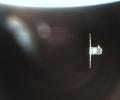
The Indian Space Research Organisation (ISRO) has successfully performed the docking of satellites as part of the Space Docking Experiment (SpaDeX). The docking was achieved after a series of maneuvers, including a trial attempt on January 12. The SpaDeX mission, launched on December 30, 2024, aims to demonstrate in-space docking technology using two small spacecraft. This technology is crucial for achieving complex mission objectives that require multiple rocket launches.
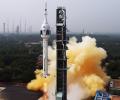
ISRO Chairman V Narayanan announces ambitious space program goals, including landing Indians on the Moon by 2040 and launching the 'Gaganyaan' mission in 2027. The agency is also working on a national space station and uncrewed missions.

Director of Indian Space Research Organisation's Space Applications Centre based in Ahmedabad, Dr Ranganath R Navalgund said the terrain mapping camera, an Indian instrument on the lunar mission, has found "new types of rocks" and hollow tunnels.
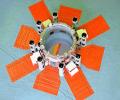
The Indian Space Research Organisation will open 2025 scoring a century orbiting the country's navigation satellite 2,250 kg NVS-02 with its rocket Geosynchronous Satellite Launch Vehicle (GSLV)-F15.

Indian Space Research Organisation's 101st mission from Sriharikota, an earth observation satellite onboard the agency's trusted Polar Satellite Launch Vehicle (PSLV) rocket, could not be accomplished on Sunday following a pressure issue in the third stage of the launch vehicle, the space agency said.
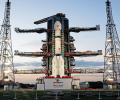
The imaging technology in Nisar can provide very high-resolution data on changes as small as one centimetre in size on the earth's surface.

India is set to take its first steps towards its own human space flight when the uncrewed Gaganyaan mission soars to the skies later this year. Private players in the space sector are also gearing up for launching satellites on home-built rockets.

ISRO stated that the disengagement of at least one contact -- in both the main and redundant paths -- of a connector led to the failure of NVS-02.

'With India's growing capabilities in the space sector, this creates promising opportunities for enhanced collaboration and market access.'

From a surge in startups to crewed mission preparations, 2025 marks a transformative year as India eyes $44 billion space economy by 2033.

The satellite, weighing about 4,410 kg will be the heaviest to be launched from the Indian soil and into a Geosynchronous Transfer Orbit (GTO), the space agency said. The satellite will travel onboard a LVM3-M5 rocket, dubbed as 'Bahubali' for its heavylift capability.
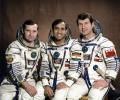
ISRO has to select astronauts, training them to withstand the space environment, and then bring them back to earth and rehabilitate them.

Alur Seelin Kiran Kumar was on Monday appointed as the new Indian Space Research Organisation chief. Kumar succeeds K Radhakrishnan, who retired on December 31, 2014, as the eighth chief of the prestigious space dispensation.
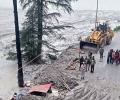
Experts question whether a cloudburst caused the recent flash flood in Uttarkashi, India, citing insufficient rainfall and other potential factors like ice chunks, rockfalls, or landslides.

Gujarat holds the largest area under wetland with over 3.47 million hectares.

Rupani also praised Ram for his 'engineering skills' by having a bridge constructed between India and Sri Lanka.
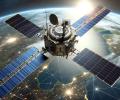
India is marching towards becoming the fourth country in the world to have space docking technology.

The third and final test in the series of landing experiment (LEX-03) was conducted at 07:10 1ST at the Aeronautical Test Range in Chitradurga, Karnataka.

Small satellites, besides being cost-effective, can replace larger satellites and take less time to build, Indian Space Research Organisation Satellite Centre Director K N Shankara said on Thursday.

The 43.43 metre tall rocket lifted off at 5.28 pm from the second launch pad at the Satish Dhawan Space Centre in Sriharikota

Heralding a new era, India on Friday night launched its heaviest commercial space mission ever with its polar rocket successfully putting five British satellites into the intended orbit after a flawless takeoff.

'ISRO facilities are very expensive and any damage caused by these start-ups can create havoc to our space programme.'
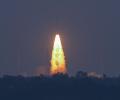
A PSLV rocket carrying Earth observation satellite EOS-09 failed to launch from the Sriharikota spaceport early on Sunday.
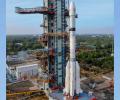
At 6.23 am on 29.1.2025, the 50.9 metre tall and weighing 420.7 ton Geosynchronous Satellite Launch Vehicle-F15 (GSLV-F15) is slated to blast off from the second launch pad carrying the 2,250 kg NVS-02 navigation satellite.

EOS-01 is an earth observation satellite intended for applications in agriculture, forestry and disaster management support, ISRO has said.

INSAT-3D, developed by the Indian Space Research Organisation and its Space Applications Centre, is designed to provide meteorological observation and monitoring of land/ocean surfaces.
Central Administrative Tribunal on Friday dismissed former Indian Space Research Organisation Chairman G Madhavan Nair's plea, seeking quashing of the Centre's decision to debar him from holding government posts for his alleged role in the controversial Antrix-Devas deal, on the ground of maintainability.

In a once-in-a-million-years encounter, a comet, the size of a small mountain, flew past Mars on Sunday.

This is ISRO's new record of launching 20 satellites, including those from the US, Germany, Canada and Indonesia.

'The heat shield technology for re-entry vehicles was first mastered in DRDO for the Agni missile.' 'This is why the Americans were so opposed to Agni in the 1980s, unlike other missiles -- it was a re-entry vehicle.'
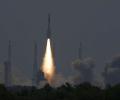
The Indian Space Research Organisation (ISRO) on Monday successfully launched a second generation navigation satellite, using a GSLV rocket with a cryogenic upper stage to do the job.

The Indian Space Research Organisation (ISRO) successfully launched its third and final developmental flight of Small Satellite Launch Vehicle here on Friday whose payloads can be used in applications like satellite-based surveillance, disaster and environmental monitoring, fire detection, volcanic activity among others.

The space agency launched 104 satellites, breaking the previous record of 37 by Russia.

The launch of Polar Satellite Launch Vehicle (PSLV-C52) is scheduled at 05:59 hours on Monday from the First Launch Pad of Satish Dhawan Space Centre, Sriharikota, the Bengaluru-headquartered space agency said.

Confusing academic freedom with the right to free speech of an individual and expecting unconditional institutional support is not realistic. Academic freedom provides an opportunity for an academic to pursue their passion and contribute to the society through the outcome of their research and/or thought process, points out N Ravichandran.
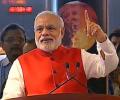
"The odds, were stacked against us. Of the 51 missions, attempted across the world so far, a mere 21 had succeeded. But we have prevailed. With today's spectacular success, ISRO joins an elite group of only 3 other agencies worldwide to have successfully reached red planet," Modi said.

The 3,357-kg satellite is slated to blast off from the Ariane Launch Complex at Kourou, a French territory located along the northeastern coast of South America, at 02:35 hrs IST. "GSAT-30 is to serve as a replacement to INSAT-4A spacecraft services with enhanced coverage", ISRO said.

The mission objective is to ensure data continuity of ocean color and wind vector data to sustain the operational applications.
 © 2026 Rediff.com - Advertise with us - Disclaimer - Privacy Policy - Sitemap - Feedback - About us - Terms of use - Grievances